From casino reporting to decision infrastructure: why self-service analytics is becoming an operator standard
Modern online casinos can manage thousands of games, dozens or even hundreds of providers, multiple brands, several regulated markets and a constant flow of launches, promotions and player activity. At that scale, simply having access to data is no longer enough. What matters is how quickly the people making decisions can get from a question to an answer.
This is one reason self-service casino analytics is becoming a much more important part of iGaming infrastructure.
We see operators moving away from a model where data access depends heavily on scheduled reports, BI teams or requests to suppliers. Instead, product, commercial, account management and operational teams increasingly expect to investigate performance directly.
The real analytics problem is no longer a lack of data
Casino operators generate enormous amounts of information every day: bets, wins, game rounds, player activity, provider performance, bonus usage, tournament participation, game launches and thousands of other events. The problem is rarely that the information does not exist but is that there can still be too much distance between the data and the person who needs to use it.
Consider a product manager trying to understand whether a newly integrated provider deserves more lobby exposure. The data may already exist somewhere in the operator’s infrastructure, but if answering the question requires requesting a custom report, waiting for another department, combining several exports and then manually comparing periods, a relatively straightforward decision becomes unnecessarily slow. The same applies when an account manager needs to investigate a specific round, when a commercial team wants to compare providers or when a promotional team needs to understand how a tournament performed.
“Operators don’t want more reports. They want answers without having to ask someone else for them,” said our COO, Dmytro Kryvorchuk. “If a product manager wants to check how a new provider is performing, or an account team needs to investigate a particular round, that information should already be available to them. Waiting for a report to be prepared turns a simple operational question into a process.”
That distinction is becoming increasingly important. The value of casino data is not determined by how much of it an operator stores but by how easily that data can be interrogated and turned into a decision.
From back office to everyday operating environment
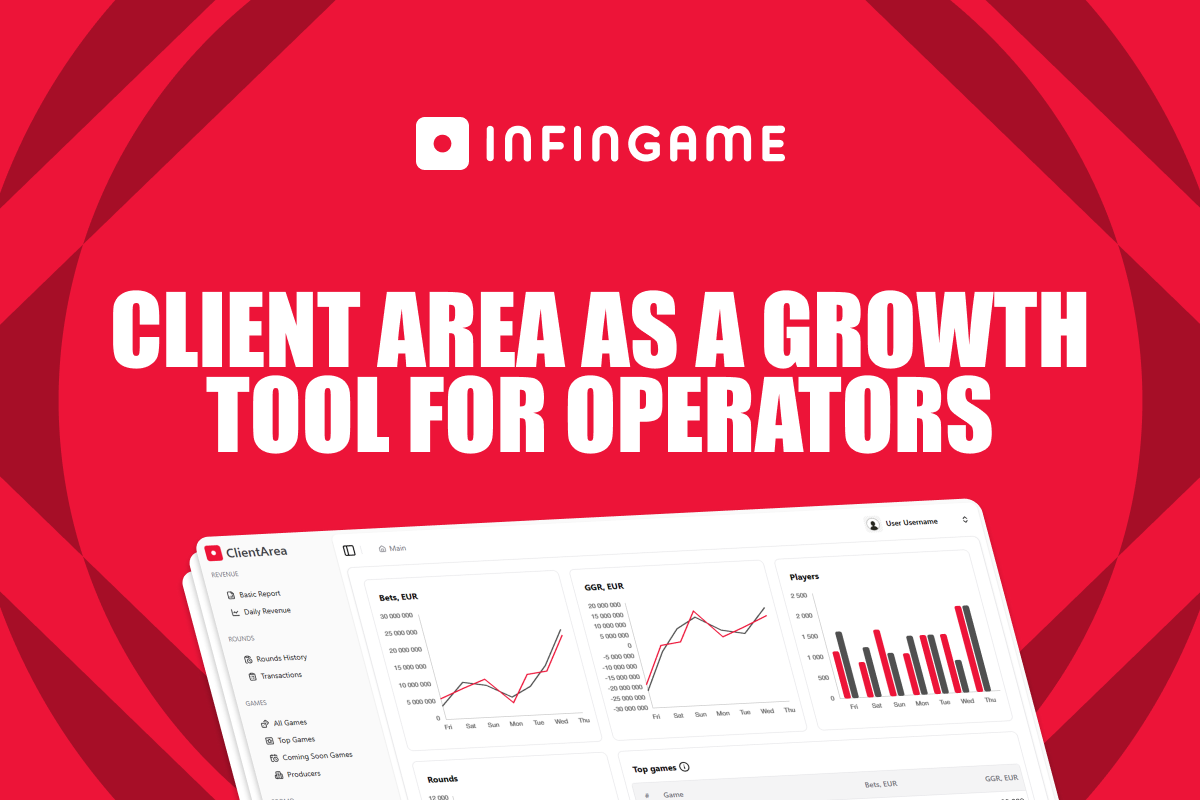
Through the Infingame Client Area, operators can work with operational and performance information in the same environment they use to manage other parts of their casino activity. Partners can monitor revenue, review player activity and transactions, inspect round histories, access game information and upcoming releases, manage tournaments and track bonuses.
Infingame’s internal research shows that the design of the client area itself is the leading factor in whether operators actually adopt self-service functionality. Convenient navigation, flexible date ranges, filters, search, custom reporting and a clear information hierarchy all determine whether analytics becomes part of everyday workflow or remains a feature that teams rarely use.
Self-service analytics creates a much shorter feedback loop. A game launched this week can be compared with existing titles without waiting for a monthly portfolio review. A provider can be assessed across different periods before a commercial discussion. Tournament or bonus performance can be reviewed while the results are still relevant to the next campaign. Self-service casino performance analytics is therefore not only about better reporting. It is also about reducing operational dependency.
Better analytics can improve content decisions
Operators now have access to larger content libraries than ever, but catalogue size alone does not determine commercial performance. The harder challenge is deciding what deserves visibility. When performance data is easily accessible, product teams can make more informed decisions around lobby positioning, provider prioritisation, content rotation and new game launches.
Instead of keeping a title prominent because it performed well several months ago, teams can check whether that performance has continued. Instead of assuming a new provider needs more time, they can compare its early trajectory with similar launches. Instead of applying the same content strategy across markets, they can investigate where individual games are actually gaining traction. Analytics therefore becomes part of content management rather than something that happens after the content strategy has already been executed.
The same principle applies to casino bonuses, tournaments and promotional tools. Running a campaign is only half of the job. Operators also need to understand what happened: whether players participated, how activity developed, which games contributed, how rewards were distributed and whether the campaign created behaviour worth repeating. When promotional management and performance information sit closer together, the learning cycle becomes faster.
A tournament should not end with a final leaderboard and an exported report. Its results can become an input into the next decision: which mechanics to reuse, which games to include, which player segments to target and how the campaign should be structured differently next time. This is especially important as promotional strategies become more segmented. The more precisely operators target campaigns, the less useful broad portfolio averages become.
The aggregator is becoming part of the operator’s intelligence layer
Once an operator has thousands of games available, the next questions are harder: which content is producing value, which providers are gaining or losing share, what should receive more visibility, which promotion mechanics work, and what should the product team change next?
“There is a big difference between having data somewhere in your infrastructure and actually being able to use it,” Kryvorchuk added. “Good analytics should reduce the distance between seeing something and acting on it. That is why we see the Client Area as part of the product itself, rather than simply a reporting interface.”
This is why we see casino analytics infrastructure moving closer to content, operational management and promotional functionality.
The important development in the future will be making analytics more configurable, more granular and more closely connected to specific actions. That includes deeper game and provider comparisons, player-level investigation, configurable reporting, promotion analysis and better ways to identify commercially relevant signals inside very large transaction datasets.
The strongest self-service environments will also need to balance depth with usability. Giving teams access to every possible data point is not useful if finding the right one becomes a specialist task of its own.
For us, that balance is central to the development of the Client Area: bringing the information operators regularly need into one place while making it practical to move from a broad performance view to the detail behind it.